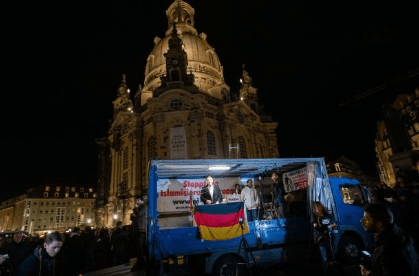
Chairman of far-right AfD party parliamentary group in Thuringia Bjoern Hoecke speaks during a demonstration of the anti-immigrant Pegida movement (Patriotic Europeans Against the Islamisation of the Occident), on February 17, 2020 in Dresden, eastern Germany. (Photo by STRINGER / AFP) (Photo by STRINGER/AFP via Getty Images)
In Germany, right-wing terror is on the rise. In the past years, events such as the 2016 mass shooting in a Munich shopping mall, the knife attack on politician Henriette Reker in 2015, the murder of Walter Lübcke and the attack of a synagogue in Halle in 2019, and the most recent terror attack in Hanau in February 2020 have left the country reeling. In light of these events, a wide range of liberal to conservative politicians and observers have issued public statements that condemn sentiments of hatred that are thought of as motivating these violent crimes. ‘Hate is a poison that… is responsible for far too many crimes,’ said chancellor Angela Merkel after the Hanau shooting. Others have explicitly accused the far-right populist party Alternative für Deutschland (AfD) of fueling hate that would lead to an increase in right-wing violence. The AfD should be considered ‘the political arm of hate,’ said Green party member Cem Özdemir in a recent interview, while AfD politicians have been vehemently protesting the accusations and denying any connections between their politics, the dissemination of hate and the rise in terror attacks in Germany.
Populism has taken flight throughout the world today, and despite an aggressive response primarily in the media, the populist movement has surged on. With recent European Parliamentary elections all but highlighting that far-right populist parties had become a mainstay in Europe as IvanKrastev has highlighted in the New York Times, one is compelled to imagine what a populist Europe means for the rest of the world. With the United States (U.S.) all but lost, except for a much-changed outcome in the 2020 presidential election, the global order and balance of power is most certain to be transformed, with the developing world once again being the greatest losers. Some of the consequences of growing populism throughout the world have been identified, for example, Max Bergmann, Carolyn Kenney, and Trevor Suttonhave highlighted the dangers of the rise of far-right populism to global democracy and security. In particular, of concern to me is the potential impact of populism on the African region. While the liberals of the international community have failed to respond adequately to rising populist movements, there has been a subtle and quiet convergence of a coalition of the radicals. This coalition is set to upset the way things are done today, all to the detriment of the most disadvantaged regions of the world.
The largest electoral exercise in the world
–17th parliamentary elections of India –
concluded on the 19th of this month. The mammoth task was carried
out over 39 days and in 7 phases to decide the fate of 543 parliamentary seats.
At the time of writing, the first post-poll surveys have begun to make rounds
in the media. According to these post-poll surveys, the incumbent
Narendra Modi led NDA (National Democratic Alliance) is all set to return to
power; the accuracy of these surveys remains to be seen. Regardless of which
party takes power, it is vital we pay attention to what these elections mean
for the world’s largest electoral democracy in times of fake news, and the
resurgence of chauvinism in the realm of high politics.
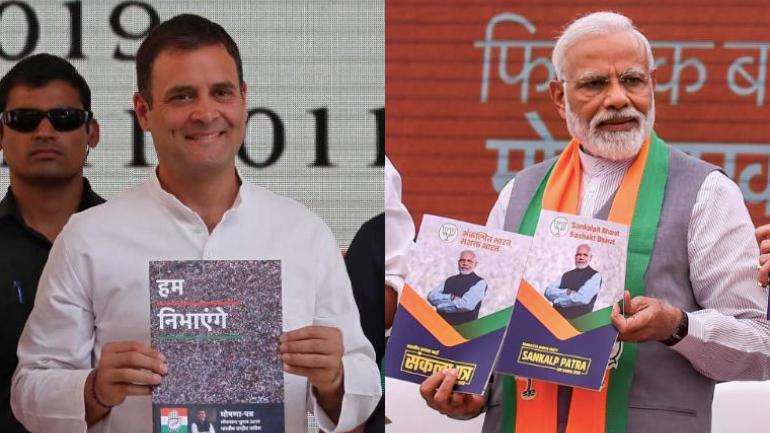
A tale of two manifestos:
To understand any election, a comparison of
party manifestos is always a good starting point. Before doing that, a general
comment on how Modi’s tenure has been covered is in order. Observers from
across the world dubbed these elections as a referendum on Modi’s tenure, and
much has been written about the rising intolerance, vigilante violence, and crackdown on dissent during Modi’s
tenure. Domestically, Modi was widely criticised for his demonetisation move,
which sent the economy into a shock. Modi’s frequent travels abroad received
their share of criticism as well for being useless, and also became a template
for hilarious internet memes.
Coming
to the manifestos of the two parties, both sought to cash in on political
rhetoric and populist imagination. The manifesto of BJP read like a PR
handout for its 5-year long tenure and sought to embellish its supposed tough
stance on terrorism as the number one item on the manifesto titled ‘Nation
First’. This section of the manifesto aimed to reinforce the rhetoric that
India is continuously facing threats, both internal and external, by cashing in
on the 14th February suicide
attack in Kashmir, stoking anti-immigrant sentiment, and labelling social
activists/dissenters as ‘left-wing extremists’. The manifesto also dedicated a
whole section to what it calls ‘cultural heritage’, which shows the party’s
intention to embark on a homogenisation drive in what is for intents and
purposes a multi-national state. Lastly, the manifesto emphasised the aspect of
development, and its aspirations to make India a global power by raising the
issue of securing a permanent seat at the UNSC.
The manifestos appeared to have been written for the consumption of India’s tech-savvy Anglophone middle-class
On
the other hand, the manifesto of the Congress party appeared radical in
contrast to its rival. The key
pledges the manifesto emphasised were a jobs revolution,
universal healthcare, end to hate crimes, increasing defence spending, among
other things. However, a closer reading of the party manifestos reveals that
they are more similar than they appeared, as Irfan Ahmad had also pointed out
in his Al Jazeera article in 2014.
Things have not changed on that front; both manifestos raved about the
discourse of development, the need to counter cross border terrorism and
promise to acquire a permanent seat for India at the United Nations Security
Council (UNSC). On the disputed and politically rebellious region of Kashmir,
both parties have pledged to take an assimilationist approach, albeit
these approaches are phrased differently. The manifestos appeared to have been
written for the consumption of India’s tech-savvy Anglophone middle-class,
which over the years has become a site for the ideological fight between the
right and the centre in Indian politics represented by the invocation of Ram
Temple by the BJP and a hat-tip to tolerance by the Congress party.
Most of the pledges and promises the
manifestos spoke of were absent from the speeches delivered by the politicians
of the respective parties while on the campaign trail. The tenor of the
election campaign appeared to be entirely divorced from the manifestos, more so
from the Congress side. BJP, on its part, left no chance of polarising the electorate
go begging.
Campaigning in the age of social media:
Political parties spent a staggering £3.8
billion in the 2014 parliamentary elections on election campaigning and other
related activities. The amount spent during the recently concluded elections
was almost double that and stood at £5.42 billion. A significant chunk
of these funds was dedicated to digital campaigning over social media
platforms, especially Facebook and Google ads. The
massive spending on campaigning points towards the fact that elections in India
revolve more around the spectacle of campaigns and are less dependent on what
the parties have pledged in their respective election manifestos. Election
campaigns in India are designed not only to entertain the audience, but also
informally known to be opportunities to make a quick buck as audiences/voters are lured with promises of cash, liquor, and even food.
It is hardly surprising that issues of critical
importance for public policy are barely discussed on the campaign trail by the
politicians in India. The recently concluded elections were no different.
Pressing matters of public policy were
conveniently elided over by politicians in their campaigning and by the media
in their coverage of the elections. Matters of public policy such as environmental pollution, rising
inequality amongst different social classes, farmer crisis, dispossession of tribal
people from their lands were either wholly pushed out of the conversation or at
best given half-hearted
and short-lived attention. The issues that were
highlighted by the media as the core issues of the elections were jobs and
economic slowdown, and national security. Additionally, BJP’s muscular
nationalism and its links to corruption have also been thrown in the mix by the
sections of media sympathetic to the Congressi
vision of India.
The move sought to project Modi as a politician with a clean image, with the interests of the poor at heart.
The discourse and rhetoric on the campaign
trail from all sides was shrill vitriol and a public mudslinging competition. Election campaigning of the incumbent BJP revolved around a
spectacle of securitisation and hyperbole. ‘Sacrifices’ of soldiers, surgical
strikes inside Pakistani territory, and a right-wing brand of national loyalty
were some of the continuously invoked themes throughout BJP’s election
campaign. A BJP candidate even praised and hailed the assassin of Gandhi as a patriot.
The polarising character of BJP’s campaign was further enhanced by a massively
potent campaign of misinformation,
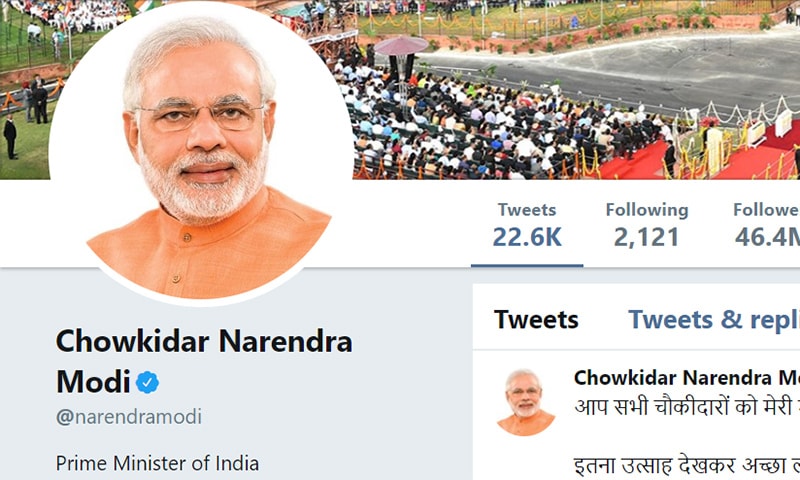
primarily carried out through the messaging app WhatsApp. The party also
undertook an ingenious PR campaign – led by Modi himself, when he added the
prefix ‘Chowkidar’ (Watchman) to his
Twitter handle. The move sought to project Modi as a politician with a clean
image, with the interests of the poor at heart. While the move may not have
succeeded in achieving that objective, it, however, succeeded in a far more
significant way. The ‘Chowkidar’ move
succeeded in shifting the focus of political discourse from serious political
and economic issues to trivial matters of self-adorned labels; a trap Indian
National Congress (INC) willingly walked into and remained caged in throughout
the elections.
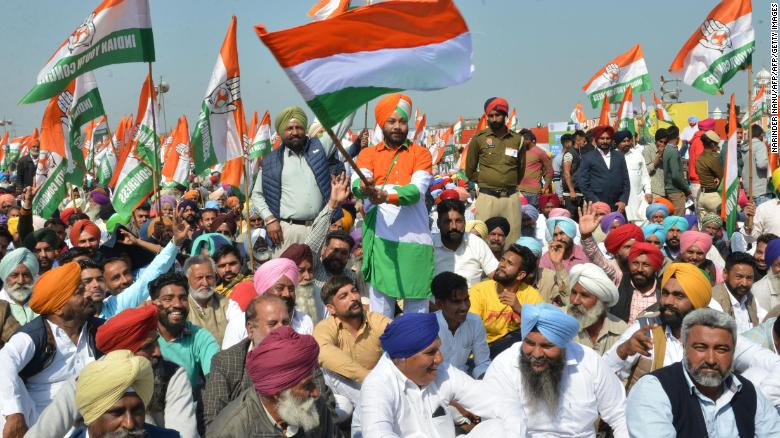
On the other hand, the election campaign of
the Congress party from the beginning and throughout the election appeared to
be interested in replicating the spectacular and entertaining model of
campaigning, something the BJP seems to have perfected. The Congress party
instead of sticking to discussing its manifesto pledges and making a persuasive
argument as to why the voters should consider its manifesto succumbed to the
tactics of the blitz, name-calling, and petty sloganeering. The President of
the INC Rahul Gandhi repeatedly pointed fingers at the alleged connivance of
Modi’s office in the mishandling of the Rafale fighter jet deal. Gandhi
almost ritualistically dared Modi to debate him on the Rafale issue, beyond
that Gandhi had no potent critique of BJP’s planned implementation of The Citizenship Bill and the National Register of
Citizens, or its planned homogenisation drive at a
national level. Gandhi appeared to be immensely pleased with himself for coming
up with the ‘Chowkidar Chor Hai
(Watchman is the Thief) slogan, which may have improved the acoustics of
Congress election rallies, but miserably failed to project the Congress party
as a viable alternative to the BJP – a development with far-reaching
consequences for Indian polity in general..
A new ‘dangerous’ India?
An explanation of why Congress chose to ape
BJP’s campaigning strategy, instead of forcefully putting forth its supposed
‘radical manifesto’ is that the policies that both these parties have pursued
when in power since the early 1990s are qualitatively no different and are
rooted in a neoliberal logic, which transcends the supposed divide of right and
centre in Indian politics. Indian politics appears to have become a prisoner of
what Marcuse called ‘liberal totalitarianism’, where the logic of neoliberal
economic development has become the only acceptable and imaginable way to move
forward. Neoliberal policies are unironically prescribed as the solution for
problems whose roots lie in neoliberal thinking.
The failure of the Congress party and its
allies to truly put progressive policies on the table and demonstrate the
political will to pursue them forcefully has made a significant contribution in
pushing Indian politics towards a dangerous trajectory. The legitimacy crisis
of Congress has deepened in recent years to such an extent that the rhetoric of
‘If not Modi, then who?’ no longer sounds absurd, regardless of how frightening
it is as a prospect. They call this the TINA; There is No Alternative.
The situation is exacerbated by the fact
that India is not a democracy in the truest sense of the word; it is a
‘quasi-democracy’ at best if I am to use Larry Diamond’s terminology, i.e.,
India is neither clearly democratic nor [overtly] authoritarian. The rise of
BJP in such a ‘quasi-democracy’ makes the prospect of a ‘reverse wave of democracy’ in India
very real. Snapping of internet services, curbs on press freedom, vigilante
violence, systematic undermining of educational institutions all in the name of
protecting the ‘national interest’ appear to confirm the trend of reversal in
India.
Idreas Khandy is a PhD candidate at
Lancaster University’s Department of Politics, Philosophy and Religion
In the seventy two years since India gained its independence from the British, a distinct precedent has been espoused throughout political discourses is that of religious difference. Established in the very partition of India, a dichotomy has formed, and grown, between India’s Hindu majority and it’s religious minorities. This is most often historically India’s Muslim majority (which is destined to become the largest single population of Muslims in the world) but has from time to time turned to Sikhs (notably in the 1980s), and other communities. This narrative of religious difference is not a impenetrable barrier to religious cohesion in India, in fact it can be argued that India displays a more sophisticated model of religion conscious democracy, though the ever growing populist narrative of India’s politics, this assessment grows weaker and weaker.



 Global Discourse Blog